Last updated on 09/23/2026 at 12:21
What Is Tupi Tea?
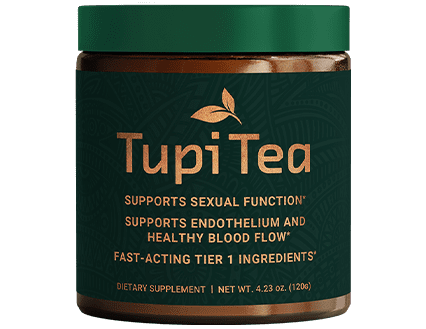
At its core, Tupi Tea is marketed as a dietary supplement built for male vitality, sold in a powdered format rather than the capsules you’d find with most competitors in this space.
Across its official marketing materials, it’s described as a herbal blend made from plant-based ingredients intended to support overall wellness, natural vitality, and healthy circulation, positioned as a simple daily addition to your routine rather than a medical treatment.
The name leans on an exotic, indigenous-sounding origin story, a common move in this corner of the supplement world where a product’s backstory does almost as much selling as its ingredient panel. But does an evocative name actually tell you anything about how well something works?
Not really — it’s packaging. What matters more is that Tupi Tea is regulated as a dietary supplement, not a drug, meaning it hasn’t gone through the rigorous testing, dosage standardization, or FDA approval process that something like Viagra or a prescription testosterone treatment has.
Think of it less like a medication and more like a fortified herbal drink — potentially useful, but operating under a much lighter regulatory leash.
- What Is Tupi Tea?
- How the Product Is Packaged and Used
- Who Tupi Tea Is Marketed To
- The Science Story Behind Tupi Tea
- The Endothelium and Blood Flow Angle
- Nitric Oxide and the Testosterone Connection
- Tupi Tea Ingredients List, Explained
- What Tupi Tea Claims to Do for You
- Tupi Tea Pricing, Packages, and Guarantee
- Red Flags to Know Before You Buy
- Safety, Side Effects, and Who Should Be Cautious
- Is Tupi Tea Worth Trying?
- Conclusion: Should You Buy Tupi Tea?
- Frequently Asked Questions
How the Product Is Packaged and Used
One independent review describes the product as a powder shipped in a 30-day supply pouch, with instructions calling for one scoop mixed into your morning coffee, tea, or smoothie.
That’s a genuinely different format than most competitors, which usually come as swallowable capsules, and the tea-like presentation is clearly part of the brand’s identity.
Oddly, not every source describing the product agrees on this basic detail — at least one online review instead describes a dosage of two capsules taken each morning with breakfast, which flatly contradicts the powder-and-scoop instructions found elsewhere.
That kind of inconsistency might sound minor, but when multiple “in-depth” reviews can’t even agree on whether you’re drinking a supplement or swallowing a pill, it’s a pretty strong signal that some of what’s circulating online wasn’t written by anyone who actually opened the jar.
We’ll come back to why that matters in the red-flags section below, but for now, just know the format — powder versus capsule — is something you’ll want to verify directly on whichever site you actually order from.
Who Tupi Tea Is Marketed To
The marketing is aimed specifically at men over 40 hoping to restore libido, stamina, and overall vitality, playing on the idea that natural testosterone support and blood flow can decline with age.
That’s a smart, if well-worn, target audience, because it taps into something a lot of men genuinely experience but rarely discuss openly: a slow, creeping sense that their energy and drive in the bedroom aren’t what they used to be.
Rather than framing this as a medical issue worth a doctor’s visit, the messaging positions Tupi Tea as a natural, lifestyle-adjacent fix — something you casually stir into coffee instead of something requiring a prescription.
This is a pattern you’ll recognize if you’ve paid attention to the broader men’s wellness supplement market over the past several years, where dozens of similarly branded products, often with exotic, ancient-sounding names, have chased this exact demographic with nearly identical promises.
None of that automatically makes Tupi Tea bad, but it does mean the playbook isn’t unique to this one brand, and knowing that helps you read the rest of the claims with the right amount of healthy skepticism.
The Science Story Behind Tupi Tea
Every supplement in this category needs a hook — some scientific-sounding mechanism explaining why a handful of herbs in a powder is going to move the needle on something as complex as libido and energy.
For Tupi Tea, that hook is the endothelium, the thin layer of cells lining every blood vessel in your body. The official product materials describe the formula as designed to support endothelium health, which is presented within the marketing as a key regulator of blood flow throughout the body.
That’s not made-up biology — the endothelium genuinely does regulate vessel dilation and circulation, and it’s a legitimate area of cardiovascular research.
Where things get murkier is the leap from “the endothelium matters for blood flow” to “this specific powdered blend of herbs meaningfully improves endothelial function in a way you’ll feel as better stamina and libido.” That’s a much bigger claim, and it’s one the marketing doesn’t back up with a
clinical trial on the finished product itself, only with the individual reputations of the ingredients involved.
The Endothelium and Blood Flow Angle
According to the brand’s own explanation, the formula addresses the vascular system through antioxidant endothelial protection from Vitamin E, vasodilation supported by Niacin, PDE5 inhibition attributed to Horny Goat Weed and its active compound icariin, and general circulatory support from Ginkgo
Biloba. Laid out that way, it does sound like a coherent little system — protect the vessel lining, widen the vessels, improve blood flow, all at once.
The catch is that this describes what each ingredient theoretically does in isolation, based on separate, unrelated studies, not how they behave combined in this exact formula and dosage.
It’s a bit like reading the résumés of four talented specialists and assuming that because each is individually qualified, they’ll automatically function as a smooth, coordinated team the moment you put them in a room together — sometimes that happens, but you don’t actually know until someone tests
it. No published clinical trial on the complete Tupi Tea formula has surfaced in any research database, which means this entire mechanism remains a plausible hypothesis rather than a demonstrated outcome.
Nitric Oxide and the Testosterone Connection
The other pillar of the pitch leans on nitric oxide, a molecule your blood vessels produce that helps them relax and widen, plus testosterone, the hormone most associated with male libido, muscle mass, and energy.
The company’s framing argues that testosterone circulates in the blood and must be delivered via blood flow to receptor tissue including the genitals, muscles, and brain, which is why Tupi Tea is positioned as addressing both the vascular delivery system and hormonal balance at once.
This is a genuinely popular narrative across the men’s health supplement space right now, largely because nitric oxide and testosterone are both real, well-understood biological players that sound impressively technical dropped into a sales page.
The catch is that “supporting nitric oxide production” or a vague notion of “hormonal balance” through herbal extracts is a much softer claim than actually raising measurable testosterone or treating erectile dysfunction.
As you’ll see in the ingredient breakdown below, the research behind several star ingredients here is considerably thinner than the confident language on the label suggests.
Tupi Tea Ingredients List, Explained
Strip away the branding and the endothelium talk, and what’s left is a fairly familiar lineup of herbs and nutrients that show up again and again across the men’s vitality supplement category.
Listed ingredients across the product’s marketing and retail listings include Vitamin E, horny goat weed extract, muira puama powder, tribulus terrestris extract, damiana leaf, maca root, cayenne fruit, and arginine.
Other versions of the official product description also mention niacin and Ginkgo Biloba as core components, alongside oat straw powder for mood support. That’s a long ingredient list, and on paper it looks impressive, but length alone doesn’t tell you much.
What actually matters is the dose of each ingredient, which isn’t consistently disclosed across the various marketing sites, and whether real research backs the claims being made about it. Let’s walk through the headline ingredients one at a time.
Horny Goat Weed (Epimedium / Icariin)
Horny goat weed, also known as Epimedium, is probably the single most recognizable ingredient in this formula, and its reputation rests on a compound called icariin.
Icariin functions as a PDE5-inhibitor, working through a mechanism similar to prescription erectile dysfunction medications, though research suggests it’s considerably weaker, and much of the strongest supporting evidence still comes from animal studies rather than large human clinical trials.
That doesn’t mean it does nothing — the mechanism is biologically plausible, which is exactly why this ingredient keeps showing up in formula after formula in this category.
But there’s a meaningful gap between “this compound can theoretically relax blood vessels the way Viagra does” and “this specific dose, in this powder, will noticeably improve your stamina or libido.” Dosing matters enormously here, and since Tupi Tea’s public marketing doesn’t consistently disclose
the milligram amount of horny goat weed extract or its icariin concentration, there’s genuinely no way to know whether the amount in each scoop is anywhere close to what’s been used in studies showing a benefit.
Maca Root
Maca root has built a reputation as “Peru’s natural Viagra,” and it’s one of the more studied ingredients on this list, which sounds like good news until you look closely at what those studies actually found.
An independent fact-check of the specific claim that maca root is “scientifically proven” to boost libido in humans rated that framing as misleading, noting that while several small randomized controlled trials did find statistically significant improvements in sexual desire, the systematic reviews
synthesizing that research describe the overall evidence as too limited to draw firm conclusions.
In plainer terms, maca root shows genuine promise, and the early signals are more encouraging than for most herbal ingredients on this list, but “promising early signals in small studies” is a very different claim than “scientifically proven.” That distinction matters when a sales page implies a
certainty the underlying research simply doesn’t support yet.
Tribulus Terrestris
Tribulus terrestris gets included in nearly every testosterone-adjacent supplement on the market, largely on the strength of its folk reputation, but modern research paints a far more mixed picture than the marketing suggests.
A review of tribulus terrestris research on erectile dysfunction and testosterone found that most studies examined did not report significant changes in androgen levels after supplementation, and that only a small number showed a modest testosterone increase, primarily in men who already had low
baseline levels due to hypogonadism. That same body of research concluded that the overall evidence supporting tribulus for improving erectile function carries a low level of certainty, meaning the existing studies are small, inconsistent, or not rigorously designed enough to be confident in.
Separately, tribulus has shown some preliminary signals for supporting healthy blood pressure and cholesterol, though that evidence in humans remains limited as well.
The honest summary: tribulus is generally considered safe for most healthy adults, but if you’re buying Tupi Tea specifically hoping it will meaningfully raise your testosterone, this ingredient’s research doesn’t give you strong grounds for that expectation.
Other Supporting Ingredients
Rounding out the formula, muira puama, damiana leaf, and cayenne fruit are herbs with long histories of traditional use in South American and folk medicine for energy, mood, and circulation, though none carry the kind of robust modern clinical evidence that would let anyone confidently promise
specific results.
Arginine is a genuinely interesting inclusion since it’s an amino acid your body actually uses to produce nitric oxide, giving it a more direct biochemical link to the blood-flow story than the herbal ingredients, though oral arginine is also known for relatively poor absorption at lower doses.
Niacin, otherwise known as vitamin B3, does have a well-documented effect on blood vessel dilation — the harmless “niacin flush” you may have heard of is a real side effect of this exact mechanism — making it one of the more scientifically grounded ingredients in the mix.
Ginkgo Biloba and oat straw powder close out the list, contributing circulatory and mood-related traditional benefits respectively, mostly on the strength of history and small preliminary studies rather than large, definitive trials.
None of these raise obvious safety concerns on their own at typical doses, but that reassurance only goes so far when the actual amounts used in Tupi Tea aren’t published anywhere you can verify.
What Tupi Tea Claims to Do for You
Pulling the marketing claims together, Tupi Tea is positioned to support increased energy and stamina, a stronger and more consistent libido, improved erectile firmness, better mood, and a general sense of restored confidence, all wrapped in the promise of a natural alternative to prescription
options. Even the official product page includes standard disclaimer language stating the product is not intended to diagnose, treat, cure, or prevent any medical condition, and that individual results and experiences may vary.
That disclaimer sits on virtually every dietary supplement sold in the United States, and it’s there for a legal reason: without FDA approval as a drug, a company cannot legally promise it will cure or treat a specific medical condition like erectile dysfunction, even while the surrounding sales
copy paints a much bolder picture through implication and anecdote. Reading those two things side by side — the confident sales language and the cautious disclaimer sitting right beneath it — tells you almost everything you need to know about how much weight to put on the promised outcomes.
Treat every benefit listed here as a hopeful possibility tied to the ingredients involved, not a guaranteed outcome you’re purchasing along with the jar.
Tupi Tea Pricing, Packages, and Guarantee
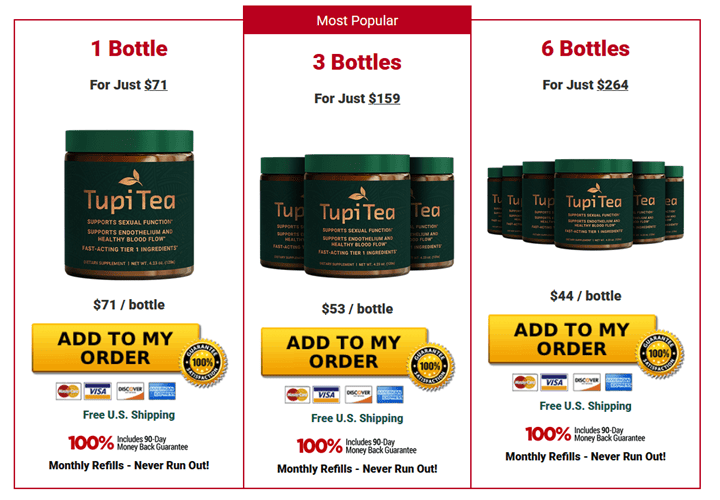
Tupi Tea is sold in three package tiers: a single jar for $79, a three-jar bundle for $177 (working out to $59 per jar), and a six-jar bundle for $294 (working out to $49 per jar), all sold as a one-time payment rather than a recurring subscription, and backed by a 90-day guarantee.
That tiered structure is extremely common in the direct-to-consumer supplement world, designed with a specific psychology in mind: the steeper discount on bulk packages nudges you toward a multi-month commitment right out of the gate, on the logic that a “natural” supplement needs sustained use
before you’ll notice anything. Is that a genuine reflection of how long the ingredients take to work, or just a proven sales tactic that maximizes average order value? Honestly, there’s no way to know for certain from the outside. Here’s how the packages compare side by side:
| Package | Price Per Jar | Total Price | Approximate Supply |
|---|---|---|---|
| 1 Jar | $79 | $79 | 30 days |
| 3 Jars | $59 | $177 | 90 days |
| 6 Jars | $49 | $294 | 180 days |
A 90-day guarantee is on the longer side compared to many supplements, which typically offer 30- or 60-day windows, and a longer trial period is generally a good sign since it gives your body real time to respond before you’re locked in.
That said, a guarantee is only as good as the company standing behind it, and the specific refund process — whether you need to return empty jars, cover return shipping, or email a specific address — tends to be buried in the fine print rather than the headline offer.
Before you buy anything, read the actual refund terms on whichever site you’re ordering from in full, rather than assuming “90-day guarantee” automatically means a hassle-free refund.
Red Flags to Know Before You Buy
Every honest supplement review should weigh the good and the concerning in equal measure, and while researching Tupi Tea, a few patterns came up that deserve your full attention before you hand over any payment information.
None of what follows proves Tupi Tea is a scam outright, and plenty of legitimate supplement brands end up with messy online footprints simply because of how affiliate marketing works across this entire industry.
But taken together, these are patterns strongly associated with lower-quality or opportunistic supplement operations, and they’re worth more than a quick scroll past.
Multiple “Official” Websites
While researching this review, several different websites turned up, each one presenting itself as the official home of Tupi Tea, with slightly different domain names, slightly different formatting, and in a few cases, slightly different product descriptions.
One of these domains was specifically flagged by the site-trust analysis tool Scamadviser as having a very low trust score, which the tool describes as indicating a strong likelihood that a website carries scam-like characteristics.
Having a single product spread across five or six lookalike domains is a pattern strongly associated with affiliate marketing setups, where multiple independent marketers each spin up a near-identical storefront to capture search traffic and earn a commission, rather than one company running one
clearly accountable website. If you do decide to try this product, that alone is a strong argument for double- and triple-checking exactly which URL you’re entering payment details into, rather than trusting the first result that shows up.
A Review Ecosystem Full of Duplicated Content
The second pattern is just as telling: a large share of the “in-depth” Tupi Tea reviews online follow an identical structural template, right down to the same numbered section headings covering an introduction, ingredient analysis, safety notes, a customer review summary, a complaints section,
ordering instructions, a pros-and-cons list, a doctor’s warning, an FAQ, and a final verdict.
Several of these reviews weren’t even hosted on supplement or health-focused websites — instead, they turned up as PDF documents uploaded to the servers of unrelated organizations, including a hospital, a cancer registry association, and a disability advocacy nonprofit, none of which have any
obvious reason to be publishing supplement reviews. That’s a well-documented pattern in aggressive affiliate campaigns, where content gets uploaded wherever a website has an open form or a security gap, purely to farm search visibility rather than genuinely inform anyone.
Combine that with the earlier contradiction over whether the product is a powder or a capsule, and the picture that emerges is one where a meaningful chunk of the glowing “reviews” you’ll find with a quick search were probably never written by someone who used the product at all — which should lower
your confidence in anything you read outside the official site itself.
Safety, Side Effects, and Who Should Be Cautious
Because the formula includes herbs capable of affecting blood pressure and hormone levels, reviewers commonly suggest checking the full ingredient list with a doctor before starting it if you have any underlying health conditions, and mild digestive discomfort or an allergic reaction is possible in
sensitive individuals, as with most herbal blends.
There’s a specific interaction worth taking more seriously than generic caution here: because horny goat weed’s active compound works through a PDE5-inhibiting mechanism, in the same category (though much weaker) as prescription drugs like Viagra or Cialis, combining it with nitrate medications
commonly prescribed for chest pain or heart conditions could theoretically cause a dangerous drop in blood pressure.
If you’re on blood pressure medication, blood thinners, nitrates, or you have an existing heart condition, this isn’t a “maybe check with your doctor eventually” situation — it’s a “talk to your doctor before the first scoop” situation, full stop.
Anyone currently managing a diagnosed case of low testosterone or erectile dysfunction is generally better served getting an actual hormone panel and a conversation with a urologist or endocrinologist before spending money on an unregulated powder promising to fix the same problem from a jar.
Is Tupi Tea Worth Trying?
So where does all of this leave you?
Tupi Tea isn’t obviously a scam in the sense of taking your money and shipping nothing, and its ingredient list, while not transparently dosed, is built from herbs and nutrients generally recognized as safe, several of which have at least some legitimate research pointing toward mild benefits for
circulation, mood, or sexual wellness in certain people.
At the same time, it’s nowhere near the breakthrough, science-backed formula the sales copy implies, and the messy web of lookalike domains and templated, likely-fabricated reviews should genuinely factor into your decision, not just the ingredient panel on its own.
Here’s where it stands, side by side:
| Pros | Cons |
|---|---|
| Ingredients include several with genuine, if modest, research behind them | The finished formula itself has not been independently clinically tested |
| Powder format may appeal to people who dislike swallowing capsules | Exact dosages of key ingredients aren’t consistently disclosed |
| 90-day money-back guarantee is longer than most competitors offer | Sold across multiple different “official” lookalike websites |
| Standard FDA disclaimer language is present and legally compliant | Online review ecosystem is heavily saturated with templated, non-independent content |
If you go in with realistic expectations — treating this as a mild, possibly-helpful addition to a healthy lifestyle rather than a replacement for medical care or a guaranteed fix — and you buy directly from a single, clearly verified source while reading the actual refund policy first, the downside
risk is mostly financial rather than dangerous for most healthy adults.
If instead you’re hoping for something closer to a prescription-strength solution to a genuine, persistent issue with libido, energy, or erectile function, your time and money are almost certainly better spent starting with an actual conversation with a doctor, who can rule out underlying causes
like low testosterone, cardiovascular issues, diabetes, or medication side effects that a herbal tea powder was never going to fix on its own.
Conclusion: Should You Buy Tupi Tea?
Tupi Tea sits in a strange, increasingly crowded corner of the wellness industry — a product built on a real, if oversold, biological narrative about blood flow and vitality, wrapped in ingredients that mostly range from “genuinely promising but not proven” to “traditionally used but thinly
studied,” and sold through a marketing ecosystem that includes some legitimately concerning red flags alongside a fairly standard herbal supplement pitch.
The honest takeaway is that this isn’t a product I’d tell you to run toward with total confidence, and it isn’t one I’d call a guaranteed waste of money either — it lands in the reasonable middle, where your own health situation, expectations, and risk tolerance should do most of the deciding for
you.
Before spending $79 or more on a jar of powder, it’s worth asking honestly whether the fundamentals — sleep, stress, exercise, alcohol intake, and any medications you’re on — have already been ruled out as the real source of low energy or libido, since those factors carry a dramatically stronger
evidence base than any herbal blend on the market. And if you do decide to give it a shot, buy directly from a single, verifiable source, read the refund policy before checkout, and loop in your doctor first if you’re on any medication affecting blood pressure or your heart.
Frequently Asked Questions
Is Tupi Tea FDA approved?
No. Tupi Tea is sold as a dietary supplement, and its own marketing states plainly that it is not intended to diagnose, treat, cure, or prevent any medical condition.
Dietary supplements in the United States are regulated differently from prescription drugs and don’t require FDA approval before hitting the market, which is standard across this entire product category, not unique to this brand.
Does Tupi Tea actually increase testosterone?
The research here is genuinely mixed. Independent research on tribulus terrestris, one of the formula’s headline ingredients, found that most studies did not show a significant testosterone increase except in men who already had low baseline hormone levels.
No published clinical trial on the complete Tupi Tea formula itself has been made public, so any testosterone-related benefit remains an inference from individual ingredients rather than a demonstrated result of the product.
How long does it typically take to notice a difference?
Marketing materials and online reviews generally point to several weeks to a few months of consistent daily use before effects become noticeable, which lines up with how herbal supplements in this category are usually described.
Given the thin evidence base for the formula as a whole, it’s worth setting realistic expectations, and tracking your own symptoms honestly over time is a far more reliable gauge than any timeline printed on a sales page.
Why are there so many different “official” Tupi Tea websites?
This is one of the bigger red flags uncovered while researching this review. Multiple domains market themselves as the official source, and at least one has been flagged by an independent site-trust checker as carrying a low trust score.
This pattern is commonly associated with affiliate marketing setups rather than a single accountable manufacturer, so if you decide to purchase, verify carefully which domain you’re using.
Can I take Tupi Tea if I’m on blood pressure medication?
This is exactly the situation where you talk to a doctor before starting, not after.
Because the formula includes a PDE5-inhibiting compound in a similar category, though weaker, to prescription erectile dysfunction drugs, combining it with nitrate medications or certain blood pressure treatments could carry real interaction risks.
Anyone managing high blood pressure, heart disease, or taking blood thinners should get explicit medical clearance first, rather than assuming “natural” automatically means “safe to combine with anything.”.